
What it is, in one paragraph
The Victorian Midday Power Saver is an electricity offer that gives households three hours of free power every day, from 11am to 2pm. It started on 1 October 2026 and runs to 30 June 2027. You need a smart meter, the free usage is capped at 24 kilowatt-hours a day, and nobody is moved onto it automatically: you have to ask your retailer for it. The Victorian Government says around 2.6 million households are eligible.
It is Victoria’s version of the federal Solar Sharer Offer, which began in New South Wales, south-east Queensland and South Australia on 1 July 2026. Victoria sets its own regulated prices, so it runs its own scheme rather than the federal one.
The catch: free hours are paid for somewhere else
A retailer that gives away three hours of power recovers that revenue through the charges that apply the rest of the time. Prices outside the free window can be higher than on other plans, and the daily supply charge still applies every day. The government itself says the offer is best suited to households that can shift their electricity use, and requires retailers to tell you about any other plan they reasonably believe may suit you better.
So the honest question is never "is three hours of free power good?" It obviously is. The question is whether the free hours save you more than the higher prices around them cost you. That depends on one thing only: how much of your household’s use already happens, or could happen, between 11am and 2pm.
The government’s own estimate is a saving of between $149 and $1,102 a year depending on how much use a household moves to midday. That range is the point: the same offer is worth almost nothing to one house and four figures to another.
Who it suits, and who it doesn’t
It tends to suit households that are home in the middle of the day, or that can put the big loads on a timer: an electric vehicle charged at home, a pool pump, electric hot water that can be switched to heat at midday, a dishwasher, washing machine and dryer, reverse-cycle heating or cooling run while the house is occupied. Each of these is a large, movable chunk of usage, and moving it into a free window is worth real money.
It tends not to suit households that are out all day and use most of their power from 4pm to 9pm. Their usage lands on the dearer hours, and the free window covers very little. Low-usage households, such as apartments and small homes, can also lose, because the daily supply charge is a larger share of their bill and no free window can reduce it. See why your daily supply charge matters.
If you have rooftop solar, look carefully. Your panels already cover much of your midday use, so the free window replaces power you were getting from your own roof. What you give up instead can be your feed-in tariff, because the plans that carry free hours do not always pay the best rate for exported solar. On the NSW Solar Sharer plans we examined, a noticeably higher share paid nothing for exports than other plans did. See what we found when we costed Solar Sharer plans.
How to check it for your house before you opt in
- Find out when you use power. If you have a smart meter, your retailer or distributor can give you your interval data as a NEM12 file (often under "usage data" or "download my data" in their portal). It shows every half hour of the last year.
- Work out roughly how much of your usage falls between 11am and 2pm, and how much more you could move there with timers.
- Compare the whole plan, not the free hours: supply charge, the rates outside the window, and the feed-in tariff if you have solar.
- Cost the Midday Power Saver plan and your best alternative on the same year of usage. The cheaper total is your answer.
- If you switch and it does not work out, the offer has a cooling-off period and you can leave without an exit fee.
How EnergySorted costs a free window, and why we are cautious
On 28 October 2026, 431 of the 5,785 Victorian electricity plans in our catalogue included a free usage window of some kind. We cost every one of them against your usage alongside every other plan, and rank the lot by what you would actually pay over a year.
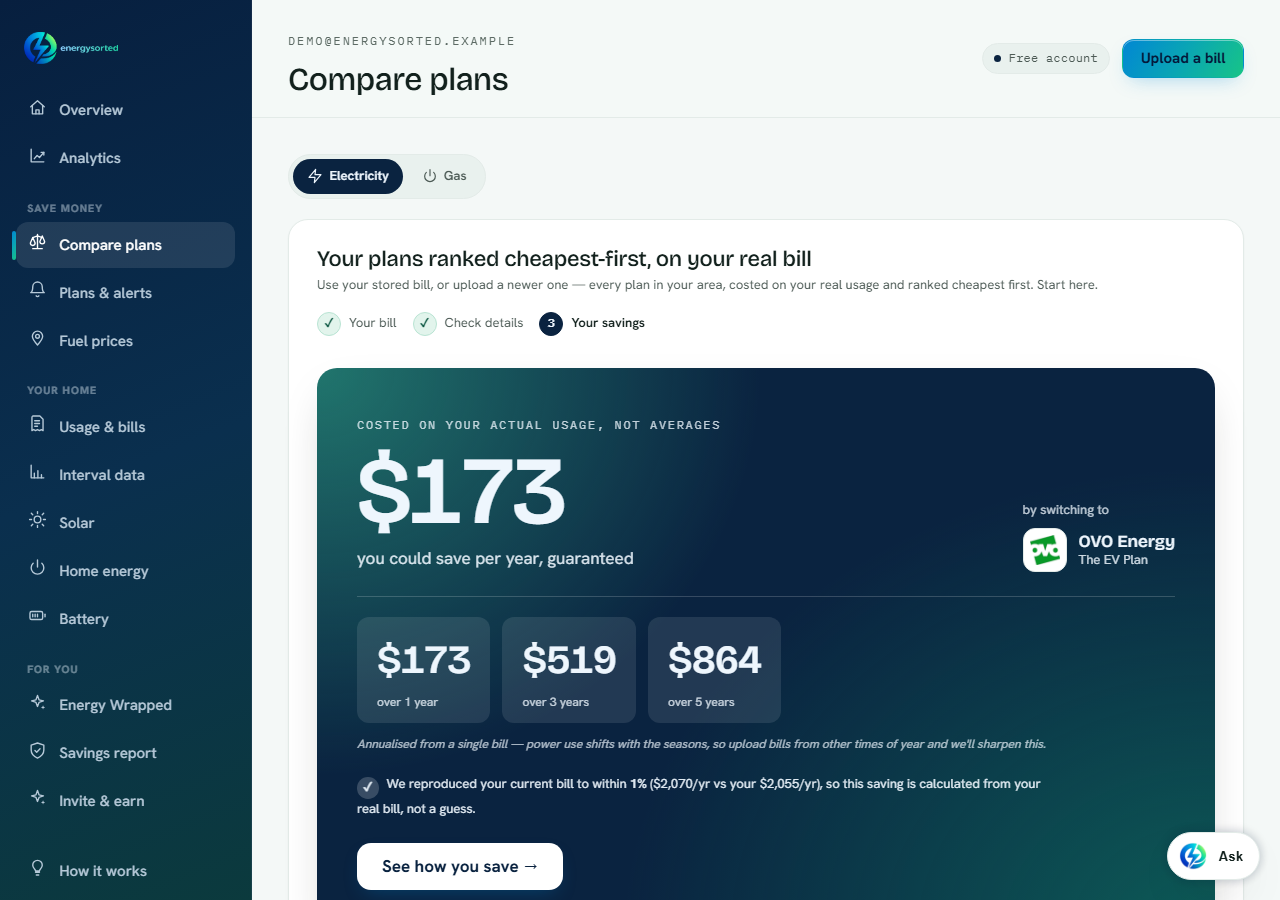
How much credit a free window gets depends on what we know about you. With a bill alone, we cannot see when in the day you used power, so we do not guess. The free hours are not counted, and the plan is shown at its worst case. If you upload your smart-meter interval data, we credit the free hours against your real usage in that window. We cap that credit at your off-peak usage and value it at the plan’s off-peak rate, so a free-window plan is never made to look better than it would really be for you.
That is deliberately conservative. Free power is exactly the kind of offer that looks unbeatable in an advert and loses on an annual bill, and we would rather understate a saving than sell you one that does not arrive. Upload a bill to start, and add your interval data for the precise answer. The free EV charging cost calculator shows what moving a charge into the window is worth on its own.
Frequently asked questions
When does the Midday Power Saver start and end?
It started on 1 October 2026 and runs until 30 June 2027.
What hours are free?
From 11am to 2pm every day, up to 24 kilowatt-hours a day. Usage beyond the cap, and all usage outside the window, is charged at the plan’s normal rates.
Am I automatically on it?
No. You have to ask your retailer to move you onto it. Nothing changes until you do.
Do I need a smart meter?
Yes. A basic accumulation meter cannot tell what time of day you used power, so it cannot separate the free hours from the rest. Most Victorian homes already have a smart meter.
Do I need solar panels?
No. The free power comes from the grid. Households without solar are often the ones with the most midday grid usage to make free, if they are home or use timers.
Will my other rates go up?
They can be higher than on other plans. The free hours are paid for through the charges that apply the rest of the day, and the daily supply charge still applies. That is why the whole-year total is the only fair comparison.
How much could I save?
The Victorian Government estimates between $149 and $1,102 a year, depending on how much use you shift to midday. Some households will save nothing, or pay more, if most of their use is in the evening.
Is it the same as the Solar Sharer Offer?
It is the same idea, three free hours in the middle of the day, but Victoria runs its own version because it sets its own regulated prices. The federal Solar Sharer Offer applies in NSW, south-east Queensland and South Australia.
Can I leave if it does not suit me?
Yes. There is a cooling-off period, and you can leave without an exit fee.
How do I know if it suits my house?
Cost it against your best alternative on a year of your own usage. Upload a bill and we cost every Victorian plan available at your address; add your smart-meter interval data and we credit the free hours against when you really use power.