
What the notice is, and why it arrived
A "your prices are changing" email or letter is your retailer telling you that the rates on your current plan will change from a set date. It is not a new contract and you do not need to sign anything: if you do nothing, the new prices simply apply from that date.
Retailers have to send it. Under the National Energy Retail Rules, which apply in NSW, south-east Queensland, South Australia, the ACT and Tasmania, a retailer must give you at least five business days’ notice before the tariffs and charges on a market offer change, and the notice must show the prices before and after the change and the date it takes effect. Queensland requires longer notice for price increases. Victoria runs its own rules, which also require advance notice. Since 1 July 2026, the national rules also limit how often this can happen: a retailer can raise prices on a market plan only once every 12 months, within July for most customers, or no earlier than the contract anniversary (with 20 business days’ notice) for plans with a fixed-price period. Victoria already had a similar once-a-year limit. So most notices now arrive in June, ahead of the July reset.
Read these four lines, ignore the rest
- The daily supply charge
- The fixed amount you pay every day, whatever you use. It has been the line that moved most in recent resets, sometimes rising while usage rates fell. See why supply charges went up.
- The usage rate (or rates)
- The price per kilowatt-hour. On a time-of-use plan there will be a peak, off-peak and sometimes shoulder rate, and they rarely move by the same amount.
- The feed-in tariff
- What you are paid for solar you export, if you have panels. It can fall at the same time as the other prices rise, and the notice must include it. See feed-in tariffs explained.
- The date it takes effect
- Usage before this date is billed at the old prices and usage after it at the new ones, so your next bill may be split across both.
Why the percentage on the notice is not your answer
Many notices quote an average change, or a dollar figure for a "typical" household. That number is calculated on someone else’s usage. A rise that is mostly in the supply charge hits a small apartment far harder than a large family home, and a rise that is mostly in the peak rate barely touches a household that runs its loads at midday.
The only figure that matters is what the new prices cost on your own year of usage, and how that compares with the other plans available at your address. Those are two separate questions, and the notice answers neither.
What to do, step by step
- Find your latest bill, or better, a year of bills. You need your usage in kilowatt-hours, split by peak and off-peak if you are on time-of-use.
- Work out what the new prices cost you over a year: usage times each new rate, plus the new daily supply charge times 365, less any solar credits at the new feed-in tariff.
- Compare that total with the best plans available at your address on the same usage. Not the advertised headline, the whole-year cost.
- If another plan is meaningfully cheaper, switching is free on most plans and takes a few minutes. Check the exit fee first; most market plans no longer charge one. See plans with no exit fee.
- If you stay, note the date. Re-check when the next notice arrives, or when any discount or benefit period on your plan ends.
Let us do the arithmetic
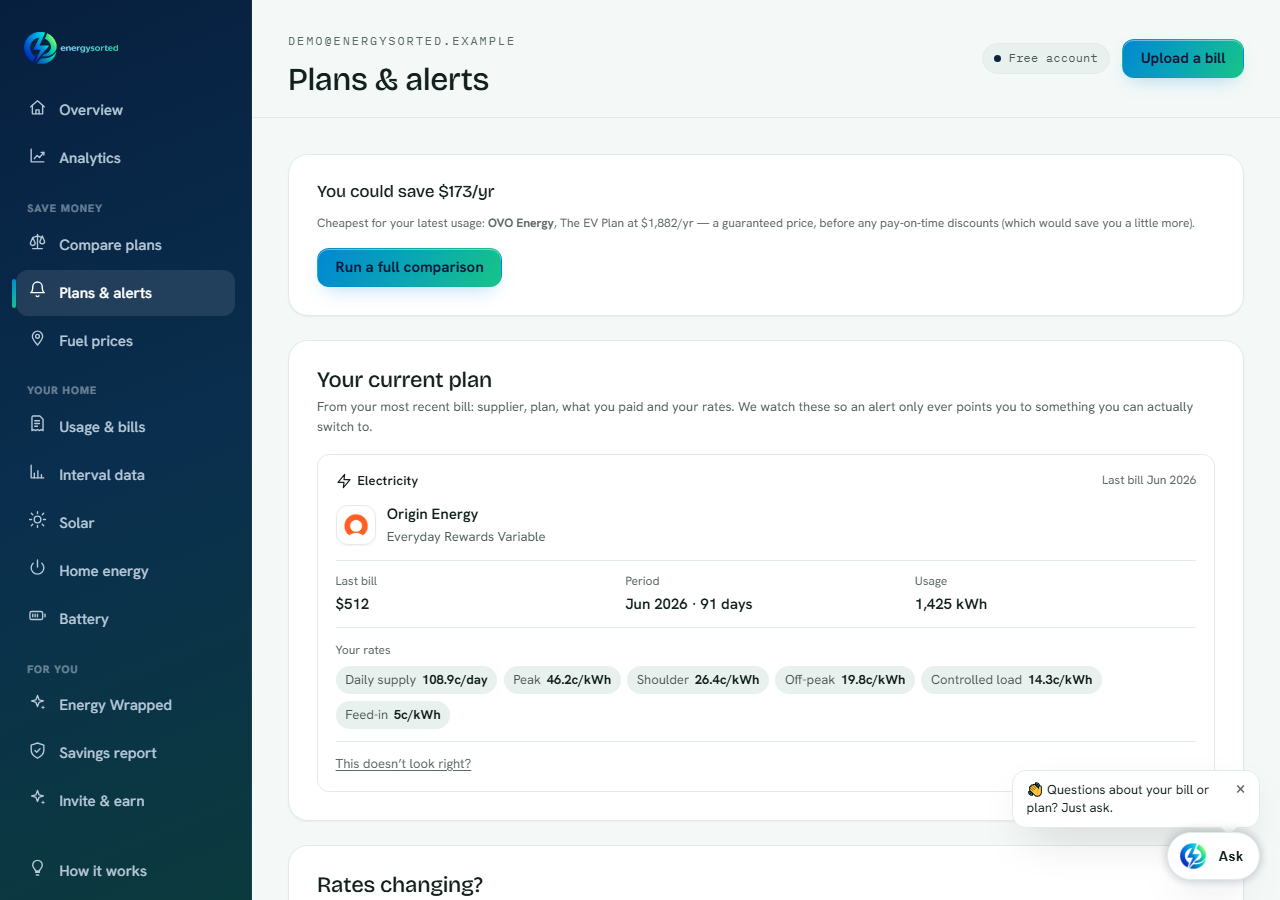
EnergySorted has a rate-change reader built for exactly this letter. Upload the notice, and we read the new rates off it, cost them on the usage from your real bills, and show you the plans at your address that still beat your plan at its new prices. If your plan is still the cheapest available to you, we say so and suggest you stay.
We check that we read the notice correctly: a rate we could not find is shown as missing, never assumed to be zero, and we flag a notice that is older than your latest bill. Start with a free bill check, then use the rate-change reader in your account. If the rise has you worried about paying, read how to pay less after a price rise.
Frequently asked questions
Do I have to accept a price change?
You do not have to stay on the plan, but you cannot refuse the new prices while you remain on it. If the new prices do not suit you, you can switch plans or retailers. Most market plans have no exit fee.
How much notice does my retailer have to give?
Under the National Energy Retail Rules, at least five business days before the change takes effect. Queensland requires longer notice for increases, and Victoria has its own rules that also require advance notice.
How often can my retailer raise my prices?
Since 1 July 2026, at most once every 12 months on a market plan under the national rules, usually in July. Plans with a fixed-price period can rise no earlier than the contract anniversary. Victoria has a similar limit. See fixed vs variable rates.
Why did my notice say prices are rising when the news said they are falling?
Headlines usually report a reference price or an average across all customers. Your plan can move differently, and the split between supply charge and usage rate can make the same change land very differently on two households.
My notice gives a yearly dollar figure. Is that what I will pay?
No. That figure is usually calculated for a typical household. Your cost depends on your own usage, time of use and solar exports.
Will my next bill show both old and new prices?
Often, yes. Usage before the change date is billed at the old prices and usage after it at the new ones, so a bill that spans the date has both.
What if I missed the notice?
Check your email, including spam, and the messages section of your retailer’s app. Your bill also shows the rates you were charged, so you can compare it with the previous bill.
Is it worth switching over a small rise?
Switching is free on most plans and takes a few minutes, so even a modest yearly saving can be worth it. The size of the rise matters less than the gap between your new price and the cheapest plan available to you.
How do I know if a cheaper plan exists for me?
Upload your bill and we cost every plan available at your address on your real usage. Members can also upload the price change notice itself and see whether their plan still holds up at the new prices.