
High is not the same as wrong
Most high bills are correct: a hot or cold quarter, more days in the period, or a price change. Those are covered in why is my electricity bill so high. A wrong bill is different. It charges you for usage you did not have, at prices you did not agree to, or leaves out a credit you are owed. Errors are not common, but they happen, and the checks below find nearly all of them.
You need this bill, the one before it, and ideally the same bill from last year. Everything you need is printed on them.
Seven checks
- 1. Is the read actual or estimated?
- Look next to the meter reading for "A" (actual) or "E" (estimated). An estimated bill is a guess based on your history, and it will be corrected later. See estimated meter reads.
- 2. Is it your meter?
- The bill shows your NMI (National Meter Identifier) and often a meter number. Check they match your property, especially after moving house, in a unit block, or in a granny flat with its own meter.
- 3. Do the dates join up?
- This bill should start the day after the last one ended. A gap or overlap means usage has been missed or charged twice.
- 4. Are the prices the ones you agreed to?
- Compare each rate and the daily supply charge with your plan details or your last price change notice. If prices changed part-way through the period, the bill should show two sets of lines.
- 5. Is it the right tariff?
- Check whether you are billed single-rate, time-of-use or with a controlled load, and that it matches what your plan should be. A tariff can change after a meter is replaced. See time-of-use vs single rate and controlled load.
- 6. Is your solar credit there?
- If you have solar, the bill should show exported kilowatt-hours and a credit at your feed-in tariff. A missing or zero export line after a meter change is a common fault.
- 7. Did a discount drop off?
- A pay-on-time or direct-debit discount disappears if a payment was late or failed. A time-limited benefit can also end. See when your discount ends.
Do the sum yourself
Every bill can be rebuilt from its own lines: each usage amount times its rate, plus the daily supply charge times the days, less any credits and discounts, then GST added. (See GST on your electricity bill.) If your sum does not land within a few cents of the bill’s total for this period, something on the bill is not what it says.
Use the total of new charges for this period, not the amount due. The amount due can include an unpaid balance or a credit carried from the last bill.
If something is wrong
- Contact your retailer first, in writing if you can, and say exactly which line you think is wrong and why. Keep a copy.
- If the read is estimated, give them your own meter reading with a dated photo and ask for the bill to be adjusted.
- Ask for the disputed amount to be put on hold while they investigate. You should still pay the part that is not in dispute.
- If you think the meter is faulty, you can ask for it to be tested. You may be charged for the test if the meter turns out to be accurate.
- If the retailer does not resolve it, contact the free energy ombudsman in your state. They can investigate and their decision binds the retailer.
If they undercharged you
A retailer that undercharged you, for example through a long run of estimated reads, can send a catch-up bill (a "back-bill"). There is a limit on how far back it can go. Under the national rules, a retailer can generally only recover undercharged amounts from the nine months before the back-bill. In Victoria the limit is four months. The limit does not protect you if the undercharge was your fault, such as refusing access to the meter. You can also ask for as long to pay a back-bill as the period it covers.
How we read your bill
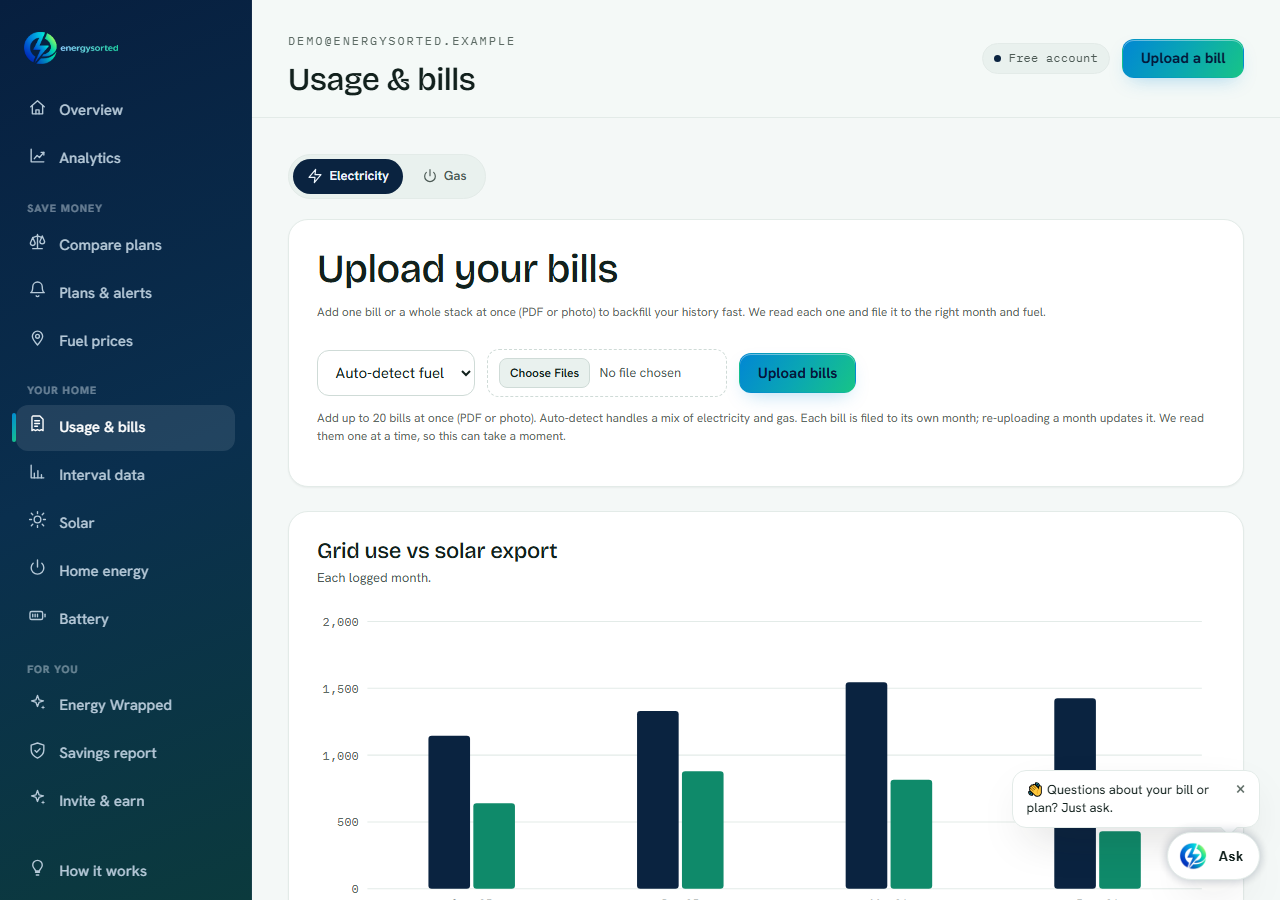
When you upload a bill to EnergySorted, we read every usage line, rate, charge and credit, then rebuild the total from those lines, the same sum described above. If our rebuild does not match your bill, we tell you rather than quietly cost you on numbers that do not add up. Upload a few bills and we line them up period by period, so a missing solar credit, a tariff change or a jump in usage is easy to see.
Check a bill free. If the bill is right but the plan is expensive, you will see every cheaper plan at your address in the same result.
Frequently asked questions
How do I know if my electricity bill is wrong?
Check the read type (actual or estimated), the meter number, that the dates join up with the last bill, the rates against your plan, the tariff, any solar credit and any discount. Then rebuild the total from its lines. If it does not add up, ask your retailer.
What does "E" mean next to my meter reading?
Estimated. The retailer did not get an actual reading and calculated your usage from your history. It will be corrected when an actual reading is taken.
Should I pay a bill I think is wrong?
Pay the part you do not dispute, and ask your retailer to put the disputed amount on hold while they investigate. Contact them before the due date.
How far back can my retailer back-bill me?
Generally nine months under the national rules, and four months in Victoria, unless the undercharge was caused by you, for example by refusing meter access.
Can I get my meter tested?
Yes. Ask your retailer. You may have to pay for the test if the meter is found to be working correctly.
Who do I complain to if my retailer will not fix it?
The free energy ombudsman in your state. They can investigate billing disputes and their decisions bind the retailer.
Why is my solar credit missing?
Often because a meter was replaced or reconfigured and the export register was not set up for billing. Raise it with your retailer straight away and ask for the credit to be back-dated.
My bill has two lines for the same tariff. Is that wrong?
Not necessarily. Bills split usage when prices change part-way through a period, or when usage falls into price blocks. Add the lines together to get your total for that tariff.
Can EnergySorted check my bill?
Yes. Upload it free. We read every line, check that the lines add up to your bill’s total, and cost every plan at your address on your real usage.